Apple Pie

I’ve often heard the phrase that something is “as American as apple pie”. But what I didn’t realize growing up is that the UK does apple pie as well. In fact, Britons make apple pie quite well.

After watching an episode of The Fabulous Baker Brothers the other day, I decided to try my hand at pie. A trip to TKMaxx later, I was the proud new owner of a Le Creuset pie dish which meant that there was seriously no backing out of this recipe!

It took quite a bit of time to prep all the apples, and the recipe that the Baker Brothers provided me with for the pastry didn’t make nearly enough – but I think the results were worth it. I’ll just need to make a few tweaks to the recipe so that the bottom pie shell doesn’t get soggy. Because nobody likes a soggy bottom.

The recipe here has been my adaptation of the Baker Brothers.

Ingredients

For the pie filling:

  • 100 grams unsalted butter
  • 1 Tablespoon cinnamon (approximate, really just add what you’d like)
  • 6 Cox apples – peeled, cored, and chopped
  • 6 Bramley apples – peeled, cored, and chopped
  • 100 grams brown sugar
  • 1 Tablespoon lemon juice (approximate)
  • granulated sugar (for topping the pie)

For the pastry:

  • 450 grams flour
  • 200 grams icing sugar
  • 220 grams butter, cold and cut into cubes
  • 8 egg yolks
  • pinch of salt
  • splash of milk
  • 2 teaspoons vanilla

Directions

1. First, make your pastry. Rub (yes, with your hands!) together the flour, icing sugar, and cold butter until they just start to come together. Then add in the egg yolks, salt, milk, and vanilla. Continue to mix until the dough comes together. You may want to put some flour on your hands before you add the liquidy stuff, otherwise you’ll end up in a bit of a sticky situation. Once you’re finished, place the dough in the fridge for at least 30 minutes.
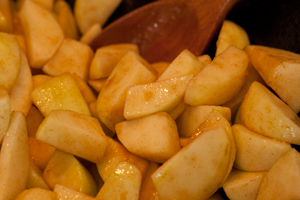
2. Next, make the pie filling. Place your butter into a large pan and let it melt completely until it starts to foam a bit, then add in all of your apples. Let them cook until the outsides just start to go soft. You want them to retain a bit of their crunch to keep them from going completely mushy when baking. Add in your cinnamon, brown sugar, and lemon juice and keep turning the apples until they’re all nicely coated. Set them aside to cool.

3. Remove your pastry dough from the fridge and divide it in half. Dust your work surface with flour and roll out the dough until it is about 1/4-inch thick and large enough to cover your pie dish. Gently wrap the pastry over your rolling pin with the sheet and carefully place it into the dish, making sure it overlaps the edges.
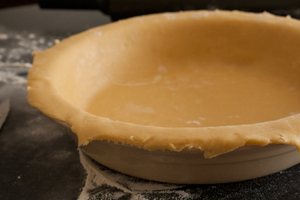
4. Preheat your oven to 375°F (190°C). Then place your prepared pie dish into the oven for around 10 minutes, weighing it down with some baking beads or dried beans. This is called blind baking and will help prevent a soggy bottom crust.

5. Remove your pie crust from the oven and pour in the prepared apple filling. Try not to get a lot of the melted butter/juices into the pie, as it will create too much liquid inside. Don’t worry – the apples will still cook down a bit and create a nice juicy pie.
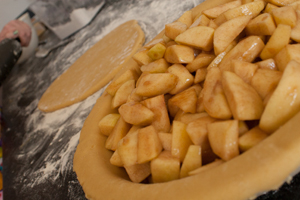
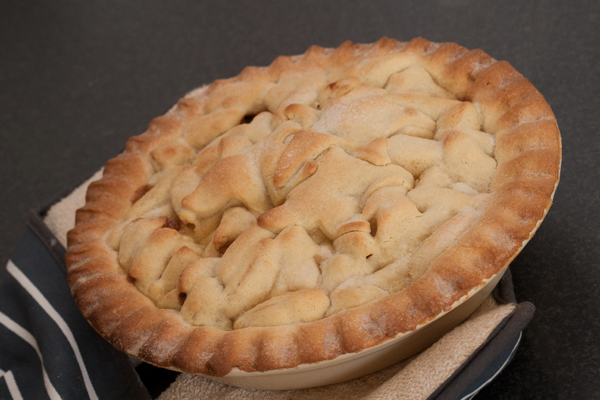
6. Roll out the second half of your pastry and repeat the transfer process to lay it over the top of your pie. Gently crimp the edges together using a fork or your fingers. If you have any extra pastry left over, cut out some cute shapes to cover the top if you’d like. Then give the top crust a generous coating of granulated sugar.
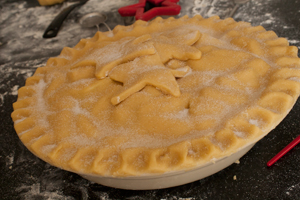
7. Bake the pie for 30 minutes until the top is golden brown. If you start to see the edges getting too dark, remove the pie from the oven and cover the edges with some aluminum foil then return it to the oven to finish baking. Let the pie stand for at least 10 minutes before serving – but it is best served warm with some vanilla ice cream or some custard.
Cinnamon Rolls

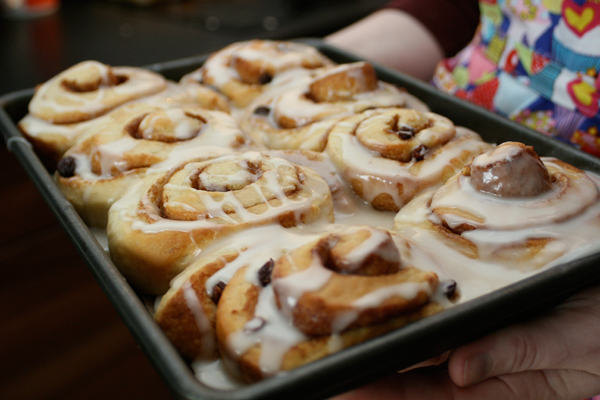
Another one of my mother’s recipes, but this one is by far one of the best ones ever. The recipe originally came from a family-run dairy and bakery, called Bergey’s dairy. We used to get them on Saturday mornings when my brother and I were little as there was a shop near our mom’s house. Eventually, mom decided to get a copy of the recipe for herself and these have been a family breakfast staple ever since.

They are really easy to make, but you just need to be patient! The best way to do them is to make the dough the night before, and wake up early to roll them out and bake them. Your entire house will smell wonderful as they are rising and baking. My mother can attest to the number of times I woke up from the smell and came downstairs to help her finish making them. And by helping, I mean eating the icing by the spoonful. But if you have kids, these are a simple way to get them involved in the kitchen, as they are pretty much foolproof.

These are best served still warm from the oven, but will keep for a day or two if kept in an airtight container. Most people like them just fine at room temperature, but I love to stick them in the microwave and reheat for about 15 seconds.

Ingredients

  • 1/2 cup very warm water
  • 2 envelopes active dry yeast
  • 1 teaspoon sugar
  • 1 cup sour cream, heated
  • 1/2 cup (115 grams) butter, at room temperature
  • 1 teaspoon salt
  • 2 eggs
  • 4 cups flour
  • 1/4 cup (60 grams) butter, very soft – nearly melted, really
  • 1/2 – 2/3 cups brown sugar, depending on how the dough is rolled
  • 1 Tablespoon cinnamon
  • raisins
  • icing sugar, sifted
  • milk
  • vanilla

Directions

1. In a small bowl, combine the warm water, sugar, and yeast. Let sit for at least 10 minutes. If the yeast does not foam, it is either too old or the milk was too warm, so dump the mixture and start again.

2. In large bowl, combine the heated sour cream and butter. Once mixed, add the salt and eggs. Gradually mix in the four cups of flour until the dough forms a soft, slightly sticky ball. Cover the bowl with a lid or some plastic wrap and put in the refrigerator overnight. When you get the dough in the morning, it will have doubled in size, so be sure your bowl is big enough that it has room to grow.

3. The next morning, tip the dough out onto a floured surface and with your rolling pin, roll the dough into a large rectangle about 1/4 inch thick.

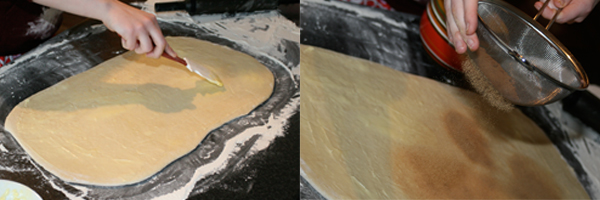
4. Once the dough is rolled out, use the very soft butter to coat the top of the dough, spreading it with a spatula (or your hands, if you don’t mind getting a bit messy).  Mix the brown sugar and cinnamon in a small bowl (feel free to experiment with the ratio of brown sugar to cinnamon), and sprinkle the mixture over the buttered dough, completely coating the entire surface.

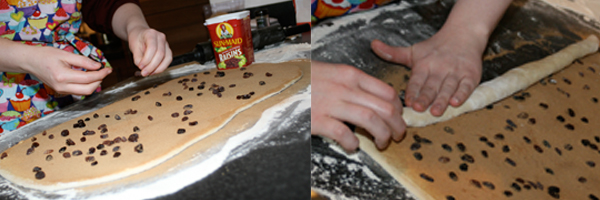
5. Sprinkle the dough with raisins, spreading them out as evenly as possible. You can add as much or as little as you’d prefer. Then gently press the raisins into the surface by grazing your rolling pin over them, being careful that you don’t actually roll the dough out more. This will help the raisins stay in place when you roll up the dough, otherwise they’ll all just fall out as you roll.

6. Starting at the longest edge closest to you, roll up the dough into a spiral, making sure that you do it evenly. Once everything is rolled up, seal up the edge by pinching the dough together. It also helps to put a bit of butter on the final edge to help it stay in place. The ends of the roll are usually kind of flimsy, so I sort of pat the ends of the roll as if I were straightening a pile of papers, to sort of “beef up” the end bits. (I realize that it’s a terrible description, but it will probably make more sense when you do it.)

7. Using a serrated knife, cut the roll in half, then each half into six rolls, giving you a total of twelve. You can get a few more out of the batch if you roll the dough out in a rectangle that is longer than it is wide, so you can slice more rolls. I managed to get eighteen out of this batch, and they were still pretty big.

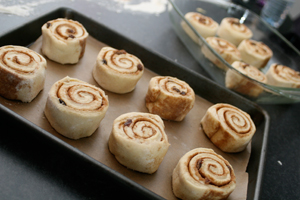
8. Place each of the slices onto a baking sheet lined with baking paper, or into a glass baking dish (as seen in the background). Be sure to leave quite a bit of space in between them as they will need plenty of room to rise, and they’ll grow a bit more when baked as well – a good rule of thumb is to keep them about 2 inches apart. (The rolls in the picture above are in mid-rise, so they’re a bit bigger than what you’ll see when you first cut them.)

9. Place the baking trays in a warm place to rise for about an hour, or until the rolls double in size. As I’ve mentioned before, if you don’t have a warm place, you can put them in a cool oven with a pan of warm water on the bottom. 

10. Preheat the oven to 350°F (175°C). Bake the rolls for 15 – 20 minutes until they start to turn a light gold color. Be sure not to overbake, or else the outside gets a hard crust, which you definitely don’t want on these. Remove from the oven and let cool for about 5 – 10 minutes.

11. Mix together the icing sugar, vanilla, and milk to create a really runny icing. Add the liquids a VERY small amount at a time – it doesn’t take as much as you think. 1/2 cup icing sugar to 4 teaspoons of milk makes a pretty good starting point. It may be easiest to mix the milk and icing sugar first, then add a few drops of vanilla once you get close to the right consistency. If you dribble some off of a spoon back into the bowl, the icing from the spoon should disappear immediately back into the rest.

12. Drizzle the icing all over the still slightly warm buns. (If the rolls are too hot, your icing will melt right off/disappear, so make sure you’ve allowed them to cool for a few minutes.) Serve them up with a nice glass of milk/coffee/tea, and enjoy.


Hot Cross Buns

As it comes up to Easter, all of the grocery stores around the UK start selling hot cross buns. So I figured I’d give them a go, having never had one in my life. They turned out alright, except that I’m pretty sure I overworked the dough a bit, so be sure to avoid that!

Ingredients

  • 3/4 cup milk
  • 1 envelope active dry yeast
  • 1/2 teaspoon sugar
  • 3 3/4 cups flour
  • 1/4 cup light brown sugar
  • 1 teaspoon cinnamon
  • 1/4 teaspoon ground cloves
  • 1/4 teaspoon ground allspice
  • 1/4 teaspoon ground nutmeg
  • 1/2 teaspoon salt
  • 1 1/2 teaspoon freshly grated orange zest
  • 2 eggs
  • 1/4 cup unsalted butter, at room temperature
  • 1/2 cup raisins
  • 1 tablespoon milk
  • 1 egg
  • 1 tablespoon milk
  • 1/2 cup icing sugar, sifted

Directions

1. Heat the 3/4 cup milk until lukewarm, then gently stir in the yeast and 1/2 teaspoon of sugar. Allow to sit for 10 minutes until it gets foamy. If the yeast does not foam, it is either too old or the milk was too warm, so dump the mixture and start again.

2. In a large bowl, combine the flour, brown sugar, cinnamon, cloves, allspice, nutmeg, salt and orange zest.

3. Create a well in the middle of the flour mixture and pour in the milk and yeast mixture. Mix until combined, then add 2 eggs and mix until the yolk disappear. Add the butter and raisins then mix for about four minutes, until the dough is smooth and elastic.

4. Place the dough into a large bowl coated with oil, cover with a clean towel, and place in a warm place to rise for about 1 1/2 hours or until doubled in size. (If your house is chilly, like mine, I suggest putting the bowl into a cool oven and placing a dish full of hot water below it. If it’s a sunny day though, a warm window sill works well!) 

5. Once the dough has risen, punch it down once, and turn it out onto a lightly floured work surface.

6. Divide the dough into 12 equal pieces and form each piece into a round ball. (I used a scale to make sure everything was even.) Place each ball onto a baking sheet lined with baking parchment, making sure they are evenly spaced.

7. In a small bowl, whisk together 1 egg and 1 tablespoon of milk. Brush the tops of each dough ball with the mixture, and save the remaining egg wash. Place a clean towel over the tops of the rolls and set in a warm place to rise for 30 minutes.

8. Preheat the oven to 400°F (200°C). Then brush the tops of the rolls again with the egg wash before placing in the oven to bake for 10 to 15 minutes, or until golden brown.

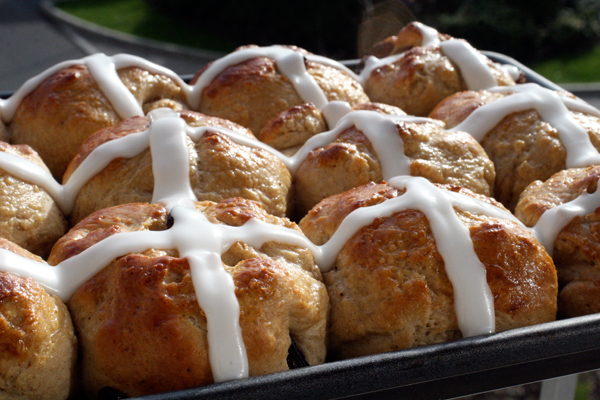
9. Allow the rolls to cool completely on the baking sheet, then combine the icing sugar and 1 tablespoon of milk. Place the mixture into a pastry bag (or a Ziploc bag with the corner snipped off), and pipe a cross over the top of each cool bun.